Thinking of hiring a fractional Head of Sales? Read this before you hire one

You helped build the company. You're probably still its best salesperson. Every big proposal crosses your desk. You're on every final call. Your newest reps watch you close, and then struggle to do it without you. You know you need a real sales leader. You just can't justify a full-time one yet.
If this sounds like you, you've probably heard of the term "fractional head of sales": an experienced sales leader who works for your company part-time, often alongside one or two others. It can be the smartest hire you make this month. It can also turn into an expensive advisor with a big title.
What decides which one you get isn't the person you hire. It's whether your company is ready, and how you set the arrangement up. That's what this post is about.
Where fractional leadership came from
Part-time executives aren't new. Interim managers, advisors and outsourced CFOs have been around for decades. Finance was the first real home of the model. In an HBR IdeaCast episode, a fractional executive explains that the practice started with CFOs: growing companies wanted senior finance expertise long before they could afford a full-time finance chief.
Then 2020 happened. Remote work became normal. Leaders learned to run teams they rarely saw in person. Plenty of senior people rethought what they wanted from work. The model spread from finance into marketing, technology, operations and even into sales.
The growth since then is real, though worth reading carefully. In the same HBR episode, researchers note that the number of people on LinkedIn calling themselves fractional leaders went from about 2,000 to more than 110,000 in two years. That measures supply, people using the label, not companies hiring.
The demand side shows up elsewhere. Executive search firm Heidrick & Struggles reports that requests for interim leaders grew 151% since 2021. And one specialist tracker counted more than 1,000 fractional executive listings from 652 companies in under ten months.
So this isn't just a temporary change after the pandemic. Job boards and search firms treat it as a real category now.
What is fractional work?
Fractional work is part-time work by a senior expert, usually on a monthly retainer, often somewhere between 5 and 20 hours a week. The key word is ownership. A fractional head of sales owns a defined commercial outcome. They run the pipeline review. They coach the managers. They make calls on process and pricing within an agreed mandate.
That's what separates them from the alternatives. A consultant diagnoses and recommends, then hands the plan back to you to execute. An interim executive fills a vacant seat, usually close to full-time, for a defined transition. A freelancer delivers a task. A fractional leader is embedded for months, if needed years, and builds the sales organization alongside your team.
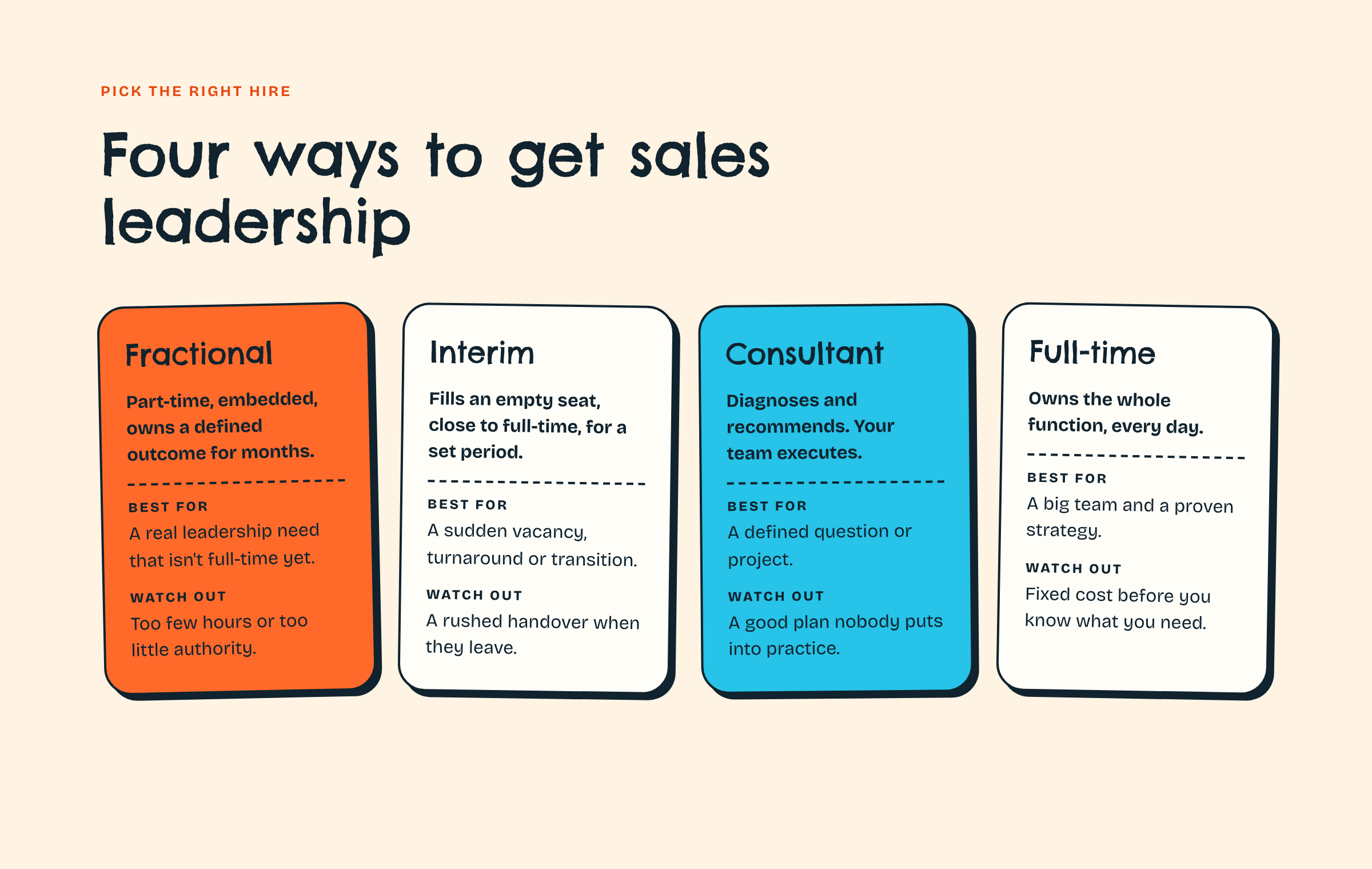
Think of it as a part-time engine builder, not a part-time mechanic. The mechanic fixes what broke. The engine builder leaves you with something that runs.
The pros, and the cons of fractional work
The upside is clear. You get experience you couldn't otherwise afford. One breakdown puts the full cost of a full-time VP, including bonus, equity, taxes and benefits, at $300,000 or more a year, against a fractional example of around $120,000. You commit less fixed cost. You can scale the hours up or down. And you buy pattern recognition: someone who has seen your exact problem at three other companies.
However, fractional isn't automatically cheaper per hour. If you buy too few hours for a big problem, you pay for a lot of context-switching and very little change. Fractional leaders can also struggle to integrate fully into client teams and cultures. They're in the room two days a week. Your culture runs seven. And without a planned exit, a fractional arrangement quietly turns into a permanent dependency with a monthly invoice.
Every one of those risks sits on the company's side of the table. That's good news. It means you can control them.
Why this fits your stage
If you're the founder or the CEO of a scale-up, your problem is rarely "we need a better salesperson." McKinsey describes the scale-up challenge as moving from founder-driven selling to a go-to-market engine that can hire and train sellers, win new customer types and run a pipeline. You're not alone in feeling it. In Datto's survey of 1,262 managed service providers, acquiring new customers was the most cited concern, named by 43%. What you need is a commercial operating system. A fractional leader can build it while you step back from every deal.
When you're not ready yet
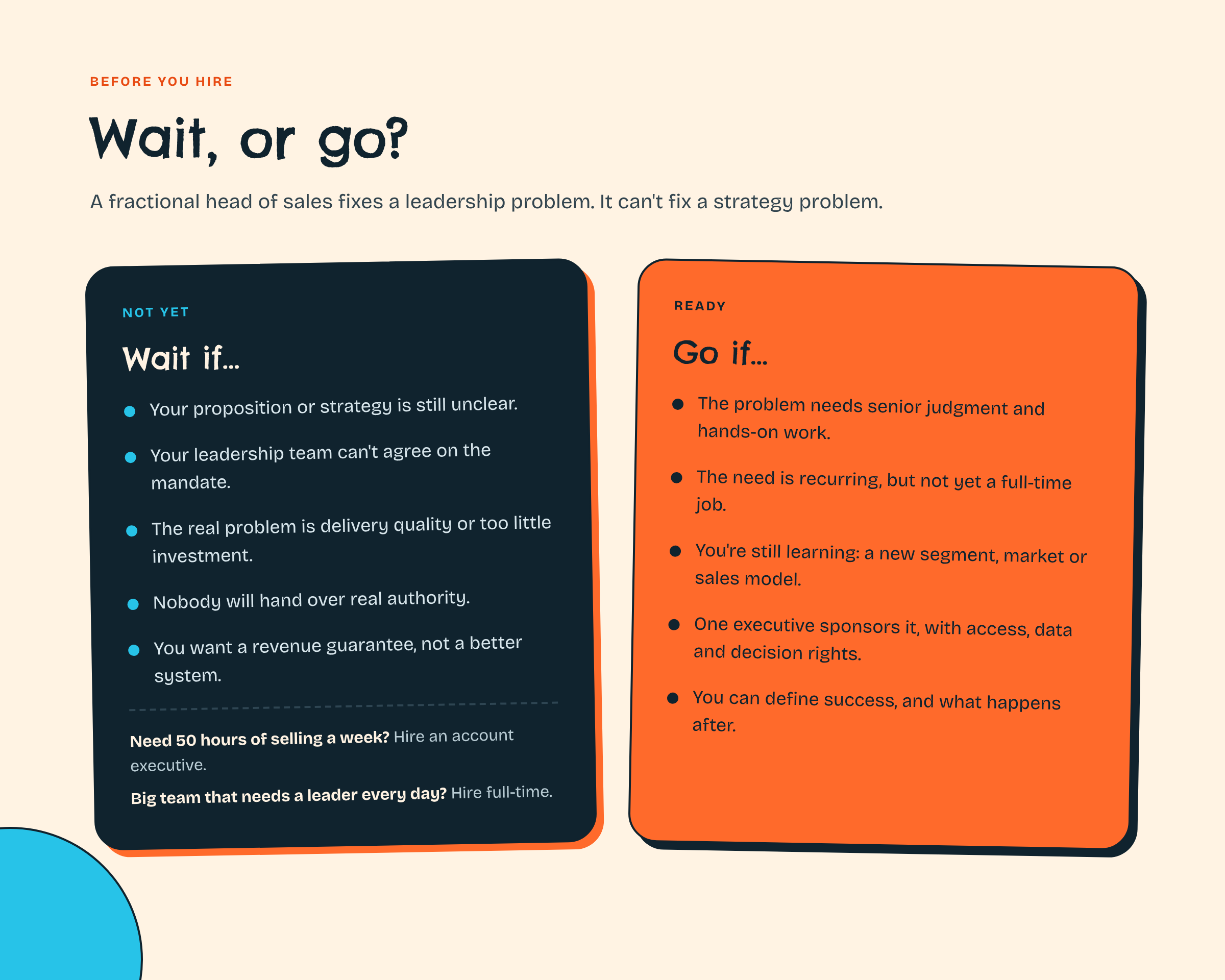
If you are radically honest with yourself, then you are in a good position to assess whether hiring a fractional leader is the right fit for your business today. Fractional leadership doesn't fix everything. You're not ready if your proposition or strategy is still unclear, because no sales leader can sell their way out of weak product-market fit. You're not ready if your leadership team can't agree on what the mandate should be. You're not ready if the real problem is delivery quality, or simply not investing enough. And you're not ready if nobody will give the new leader real authority, or if what you want is a revenue guarantee rather than a better system.
Some situations need a different hire altogether. If you need someone selling 50 hours a week, hire an account executive. If you run a large sales organization that needs daily leadership, hire full-time.
If you're ready: how to make it work
Write a one-page charter. The problem, the outcomes, the measures and what's explicitly out of scope. "Build an outbound motion that gets our two newest reps to quota within six months" beats "help us professionalize sales" every time. You're hiring a mandate, not a calendar. Pick two or three priorities, not ten. A fractional executive in the HBR episode describes agreeing two or three key priorities with the CEO, then checking them every week.
Put decision rights in writing. Can they approve discounts? Change the sales process? Recommend hires? Responsibility without authority is the fastest way to waste the engagement.
Buy enough time. Tally the real work: pipeline reviews, coaching, call reviews, deal support, analysis. Then size the hours. Two days for a problem that needs four is a false saving.
Hire on thinking, not résumé. Send an anonymized pipeline export before the second conversation and ask, "What do you see?" A strong candidate spots the stalled deals and wishful close dates in twenty minutes.
Introduce them as a leader, not a reviewer. If your team sees an outsider grading their work, they'll defend. If they see an accountable executive who's here to help them win, they'll lean in.
Run a fixed weekly cadence, with AI doing the legwork. Same pipeline review slot every week. A decision log so nobody relitigates last week's call. Call recording tools, software that records, transcribes and summarizes sales calls, let a leader scan a week of conversations in an hour. But a summary tells you what was said, not how the buyer sounded when price came up. AI shows where to listen. Judgment does the rest.
Plan the exit on day one. Agree what has to be true for the engagement to end or convert. Document everything from the first week. Review capacity every quarter. Judge a fractional leader like scaffolding: not by how long it stays up, but by whether the building stands once it comes down.
What to do this week
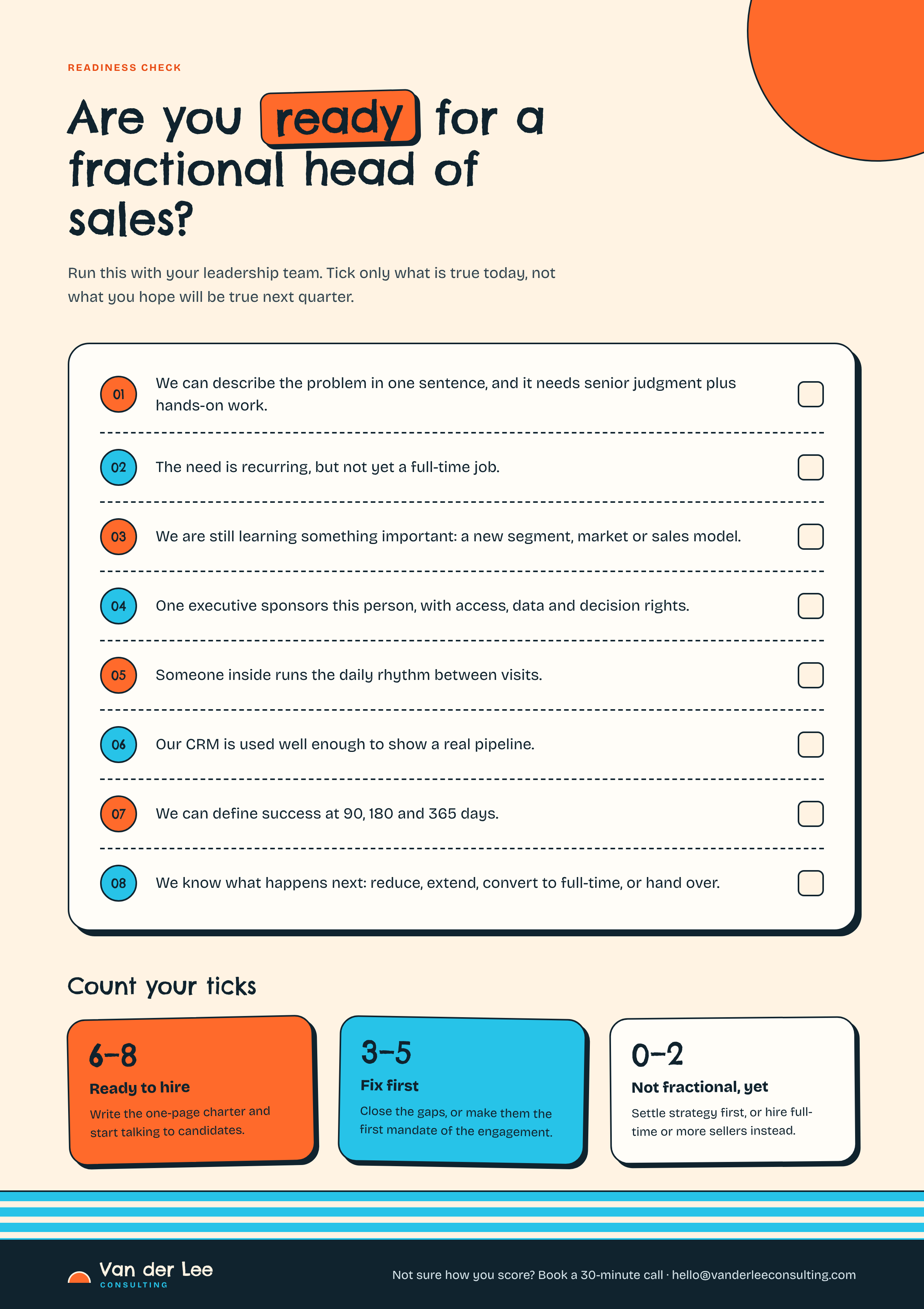
Book thirty minutes with your leadership team and run the checklist. No slides. Honest ticks only. Then write your one-sentence problem at the top of a blank page. If you can't, that's your answer for now.
If you run the checklist and aren't sure where you land, call me. Bring your answers. In thirty minutes you'll know which it is: ready, fix first, or not fractional. I'll tell you straight if fractional isn't the right fit. Book a time here or email hello@vanderleeconsulting.com.